

Panel stories with a happy ending
They left the Košice ironworks for their employees
in the 1960s to build a thirteen-story building
the Kosmalt hostel, which became
the dominant feature of the Terasa panel housing estate.
The distinct silhouette of the building that bears its name
obtained according to the type of enameled steel, which
was produced in Košice, designed by the architects
Ladislav Greč and Róbert Kandrík.
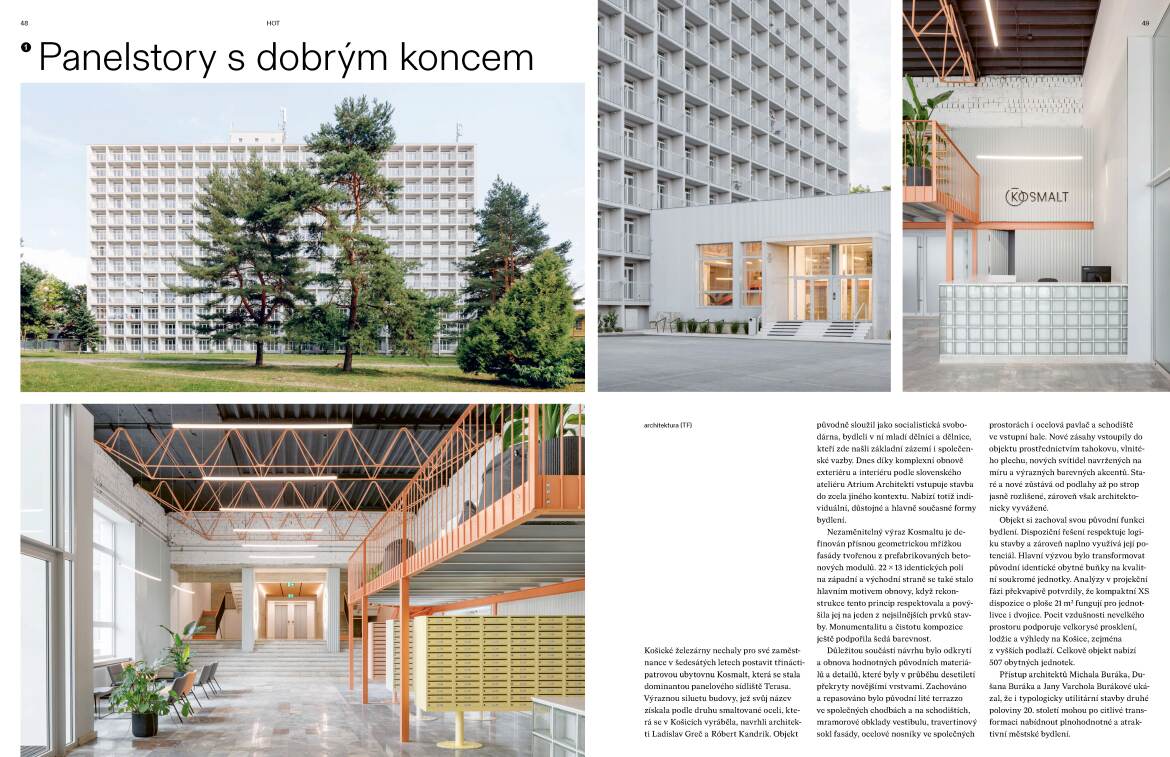
The building was originally used as a socialist freedom house,
young workers lived in it,
who found basic and social facilities here
bonds. Today thanks to a comprehensive restoration
exterior and interior according to Slovak
Atrium Architekti studio is under construction
into a completely different context. It offers individual,
dignified and mainly contemporary forms
housing.
The unmistakable expression of Kosmalt is defined
strict geometric grid
facade made of prefabricated concrete
modules. 22 × 13 identical fields
it also happened on the west and east side
the main motive of restoration when reconstruction
she respected and promoted this principle
it to one of the strongest elements of the building.
The monumentality and purity of the composition
she also supported the gray color scheme.
An important part of the design was the exposure
and restoration of valuable original materials
and details that were over the decades
covered with newer layers. Preserved
and the original cast terrazzo was refurbished
in common corridors and staircases,
marble cladding of the vestibule, travertine
facade plinth, steel beams in common
premises and a steel loft and staircase
in the entrance hall. New interventions entered into
object through expanded metal, corrugated
sheet metal, new lighting fixtures designed for
peace and strong color accents. Old
and the new remains from floor to ceiling
clearly distinguished, but at the same time architecturally
balanced.
The building has retained its original function
housing. The layout solution respects logic
construction and at the same time makes full use of its potential.
The main challenge was to transform
original identical living cells to quality
private units. Analyzes in projection
phase surprisingly confirmed that the compact XS
layouts with an area of 21 m2 work for individuals
and couples. The feeling of airiness is small
space is supported by generous glazing,
loggia and views of Košice, in particular
from higher floors. Overall, the object offers
507 residential units.
Approach of architects Michal Burák, Dušan
Burák and Jana Varchola Buráková showed
that even typologically utilitarian buildings are second
half of the 20th century can after a sensitive transformation
offer a full-fledged and attractive
urban housing.
Media: Dolce Vita 05 2026